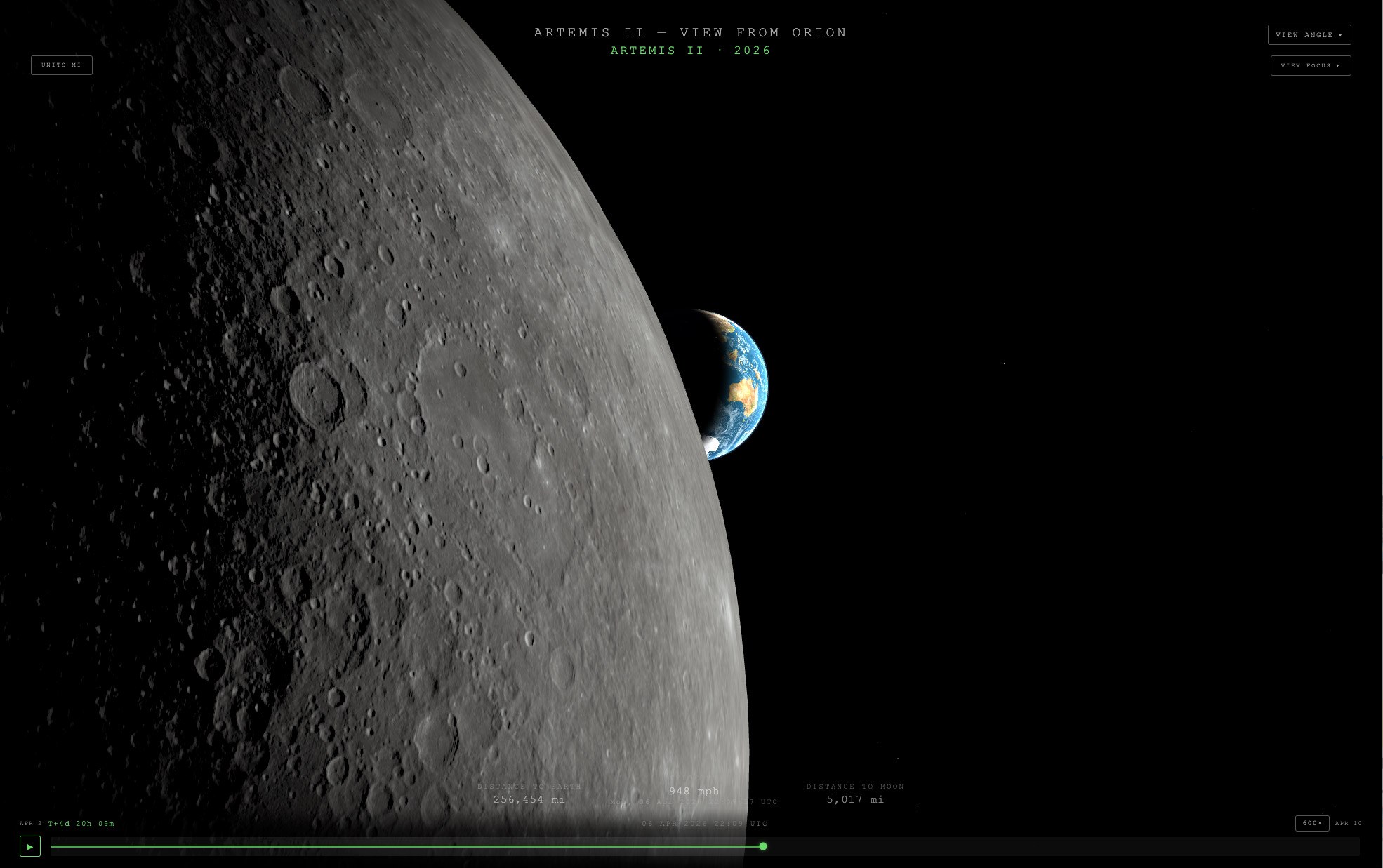
Artemis II Visualizer
A custome made visualizer for the Artemis ii Mission.
Like a lot of people, I had been following the Artemis II mission closely. I had actually photographed half of the crew years earlier for a Men's Health piece when they were newly inducted into the astronaut class, so I felt a real connection to the people aboard.
When the mission launched I went to NASA's site to follow along and ran into an immediate frustration with their built-in visualizer. The capsule occupied the center of the viewport at all times, and there was no way to look past it at the Earth or the Moon independently, the way you might if you were actually looking out a window. I already knew what the capsule looked like. I did not need it in frame constantly.
I wanted to build something that gave a terrestrial viewer a genuine sense of what the celestial bodies looked like from the Orion windows. The orbital mechanics had to be accurate, realistic texture mapping, and proper pupil dilation relative to brightness. That last detail matters more than it sounds: with the sun that bright, stars nearly disappear during the coasting phase. You would only see a full star field on the dark side of the Moon or Earth.
The result became a real accompaniment to watching the live broadcast. I could check positional accuracy, terminator placement, and global rotation in real-time. The now widely circulated earthset photograph from Artemis II was simulated near perfectly before the actual image came back, when I saw the actual photo I was really pleased that it had been simulated as well.
During the transit you could change "lenses" for a closer or wider view, and change view focus: Moon, Earth, prograde, or retrograde. Now that the transit has completed, there is a playback function with speed control to replay the mission.